Theme editor

Scale Model Shop

How to bend PE parts

jrkob

New member
Joined
Jul 23, 2022
Messages
39
Reaction score
0
Points
0
1/3
Thread owner
I have watched a couple of videos on youtube but I'm still not clear.

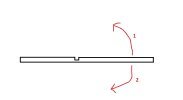
See below an example, this is the cross section of a PE part I need to bend. Forgive my drawing skills on Microsft Paint.
My PE parts show a dent on one side.

Now, is there an accepted way that it will always have to be bent (A) as per 1, (B) as per 2, (C) it doesn't matter, or (D) it will have to be bent one way but it could be 1 or 2 and I will need to "think" to know which one.

Thank you.
Bending PE parts.jpg
 
Bend it as per No.1 not the other way. It also depends on where the detail is facing but usually the scoring/crease ought to be on the inner facing of the bend. It makes for a stronger corner.
Make sure one side is clamped or pressed flat as close to the scoring/crease then with a blade slid underneath and pushed up. The scoring/crease helps the part to bend easily at that point.

Cheers,
Richard
 
Thread owner
Perfect, very clear, thank you Richard.
(I have ordered a small bender from Trumpeter I think it is)
 
Jean,
I have a PE small bender, and it's useful for long pieces, but I find I use tweezers & miniature pliers far more often - small pieces are much more common!
Dave
 
Also keep in mind that some pieces need to be bent in multiple directions, and oftentimes, the order in which you do so will matter. If you do bend 1 first you might not be able to clamp the part to make bend 2 neatly, while if you do 2 first you can clamp it to do bend 1. In other words: always look carefully at the part and imagine how it will need to be bent before you actually do so.
 
I have used PE for years and for the most part, folding is a breeze either using a folding machine, square-sectioned pliers or a knife blade and glass cutting board/ceramic tile. I am currently making the Revell 1/144 Flower Class Corvette and detailing it with 3 Eduard PE sets. However, I do have problems folding using method 1 above when the PE has to be folded over onto itself. The PE is too thick to allow it to sit flush once folded so I have to bend the PE backwards and forwards until it breaks and glue the separate pieces face to face.

Despite two pieces being lost to the carpet monster so far, it has been worth it:
Revell_Snowberry_144_2022_BM_GB_059.JPG


Dave
 
Thread owner
Thanks for the input guys, really appreciated, this is helpful.
And noted Dave on the parts that need to be folded over themselves, I understand what you mean and what your solution is.

Let me hijack my own thread with another question: man this CA glue takes hold fast on these tiny pieces. Yet it seems everybody is using this glue for PE parts.
Isn't there really no other alternative available, a glue that would give me a little bit more time to adjust the position of my PE parts if I need to (which is often the case !) ?...
 
Thanks for the input guys, really appreciated, this is helpful.
And noted Dave on the parts that need to be folded over themselves, I understand what you mean and what your solution is.

Let me hijack my own thread with another question: man this CA glue takes hold fast on these tiny pieces. Yet it seems everybody is using this glue for PE parts.
Isn't there really no other alternative available, a glue that would give me a little bit more time to adjust the position of my PE parts if I need to (which is often the case !) ?...
A small touch of white glue lets you position the small part then when satisfied apply the CA and let it flow into the joint. Use a sharp needle and wick away the excess CA surrounding the part until it dries. Remember to use as small amount of white glue as possible just to let it tack.

Cheers,
Richard
 
Thread owner
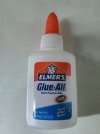
@rtfoe woaaa, thank Richard very smart ! Ok, I understand. By white glue, can I confirm that we're talking about this below one ? I have this at home already.
Regarding wiping the excess CA glue, I have observed that a simple Kleenex tissue will absord this glue. Any issue with absorbing it that way ? One potential issue I see is that some of the tissue could end up stuck on my PE part which would be attrocious.


295653153_581002200151579_338215285568390100_n.jpg
 
White glue is everyday white PVA woodworking glue. You can also find 'modellers' pva or acrylic glues that do the job as well but are a lot more expensive (woodwork glue = half a litre modellers glue 50g... but not much cheaper).

CA glue fun to use. a good tip is when you buy CA, buy a de-bonder at the same time. Not a lot of people do, and regret it after.
If you need to wick CA away, you are using far to much. Less is best.
Not all CA 'super-glues' are instant. Some are quick others give you a bit of faffing around time. If you want INSTANT you will need an accelerator or Kicker as it is sometimes called.
 
Gel type CA usually gives you wiggle room, but Richard’s technique is sound for liquid CA.

I have used PE for years and for the most part, folding is a breeze either using a folding machine, square-sectioned pliers or a knife blade and glass cutting board/ceramic tile. I am currently making the Revell 1/144 Flower Class Corvette and detailing it with 3 Eduard PE sets. However, I do have problems folding using method 1 above when the PE has to be folded over onto itself. The PE is too thick to allow it to sit flush once folded so I have to bend the PE backwards and forwards until it breaks and glue the separate pieces face to face.

Despite two pieces being lost to the carpet monster so far, it has been worth it:
Revell_Snowberry_144_2022_BM_GB_059.JPG


Dave
With respect to your folding issue Dave, have you tried opening the half etch fold line a bit with a triangular file? This was a standard technique necessary in the early days when etch was hand drawn. Sometimes the drawing technique (and poor quality cottage manufacture) gave fold lines that were not deep or wide enough, so opening them out like this eased the fitting.
 
Normally for me anything that needs to be folded to create thickness means it'll still look flat and make my own. Re creasing asTim suggested is the tried old way that works. Study the PE before using it against the plastic part. Not all PE is required seriously.
Yes Elmers Glue All white glue. Check that it dries clear.

Cheers,
Richard
 
With respect to your folding issue Dave, have you tried opening the half etch fold line a bit with a triangular file? This was a standard technique necessary in the early days when etch was hand drawn. Sometimes the drawing technique (and poor quality cottage manufacture) gave fold lines that were not deep or wide enough, so opening them out like this eased the fitting.
Thanks for the tip, Tim. :thumb2:

Dave
 
Thread owner
Not all CA 'super-glues' are instant.

Ok I wasn't aware of this ! Just had a look, my CA clearly says "instant".
Could you make a few recommendations of non-instant CA glues ? Or may be I can just go to the store and ask them.
 
Jean, most gel type CA glues have a slower setting time than the runnier ones. Loctite 401 is good but might not be available in HK.
Pete
 
In my experience, Jean, the thicker the CA the slower it sticks. Very thin CA is virtually instant but the thick stuff gives up to 10secs wiggle time.
 
Thread owner
Guys thanks for the responses.

About the bender, I am watching this video here, this chap is bending all PEs by hand, and these are a 1/700 ship. It's possible ! And crazy !
I have received my small bender today, the quality of the constructions looks quite good I think.

bender.jpg
 
Guys thanks for the responses.

About the bender, I am watching this video here, this chap is bending all PEs by hand, and these are a 1/700 ship. It's possible ! And crazy !
I have received my small bender today, the quality of the constructions looks quite good I think.

thats the same as mine......definatly makes things easier
 
Thread owner
I note that the guy in the video I posted in post #18 is using Loctite 401 and he specifically mentions that, and I quote, "I have a bit of time to put parts because 401 doesn't dry instantly".
 
Back
Top