

You are using an out of date browser. It may not display this or other websites correctly.
You should upgrade or use an alternative browser.
You should upgrade or use an alternative browser.
Spots on the Internet (2021)
- Thread starter John
- Start date
G
Guest
Guest
Dave, strange as it seems it is in fact correct.From MiniArt - 'new kit coming soon'
Rather confusing - I thought NVA meant North Vietnamese Army, but all the colour schemes are for East Germany ( DDR )
Unless NVA tanks had East German markings, I think a mistake has crept in somewhere!
Dave
The NVA was, in relation to its equipment and training, one of the strongest armies in the Warsaw Pact. It was outfitted with a large number of modern weapons systems, most of Soviet origin, from which a small portion were given back to the Soviet Union in 1990.
The remaining equipment and materials was very substantial. Large quantities of replacement parts, medical supplies, atomic, biological and chemical warfare equipment, training devices and simulators, etc. had to be disposed of.
One of the first measures taken after reunification was a survey and securing of weapons and devices by former members of the NVA. The federally operated Material Depot Service Gesellschaft (MDSG) was charged with taking custody of and warehousing this equipment. The MDSG employed 1,820 people who were primarily taken from the Bundeswehr. The MDSG was privatised in 1994. Unless the defense material was given free of charge to beneficiaries in the new federal states or other departments, to museums, or to friendly nations in the context of aid supplies in third world nations, it was destroyed.
Left behind were:
- 767 aircraft (helicopters, fixed wing aircraft), 24 of which were MiG-29s
- 208 ships
- 2,761 tanks
- 133,900 wheeled vehicles
- 2,199 artillery pieces
- 1,376,650 firearms
- 303,690 tons of ammunition
- 14,335 tons of fuel and cleaning materials

G
Guest
Guest
In this context, NVA stands for Nationale Volksarmee, “National People’s Army”.Rather confusing - I thought NVA meant North Vietnamese Army, but all the colour schemes are for East Germany ( DDR )
In the context of the Vietnam War, NVA or North Vietnamese Army is the American designation for what in English is properly the PAVN, People’s Army of Viet Nam (or in the original: Quân đội Nhân dân Việt Nam).

On the Rye Field Model Facebook page - 'available next week'
they have been busy...................
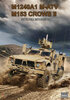
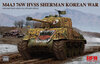
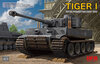
Just what the hobby needed, a Sherman and a Tiger!
Following on from the Takom 3-D printed tracks - RFM are also going down that path
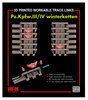
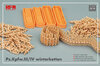
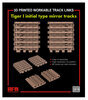
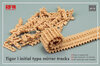
At least, they don't claim that they can be assembled within 2 hours!
Dave
they have been busy...................
Just what the hobby needed, a Sherman and a Tiger!
Following on from the Takom 3-D printed tracks - RFM are also going down that path
At least, they don't claim that they can be assembled within 2 hours!
Dave
G
Guest
Guest
To be fair, I think that two-hour claim is not inaccurate. I think it took me not much more than that to assemble the plastic Rye Field Model Sherman tracks I built a while ago, including removing all the bits from the sprue and cleaning them up.

1/3
I don’t follow your maths Dave, but I might be having a thick day....I make it (98x6) + (17 x 6), which is 690. Still high, but if the clean up is minor, then more than doable.
Looking at the first picture of the tracks - assembly to me looks like :-
One track link [Grey bit], 2 track pins [Green/Blue] so that is 288 parts for one side, 576 for both sides.
Ice cleats [Pink bits] 3 parts - 17 per side so that is 51 parts, both sides 102 bits of yummy carpet monster food.
Total parts 678 !!!
[Matron I need a lie down now!!!! :tongue-out3: :smiling::smiling::smiling:]
Think I'll stick to Friuls or MasterClub at least it keeps me out of the wife's way!!
Paul.
:smiling:
One track link [Grey bit], 2 track pins [Green/Blue] so that is 288 parts for one side, 576 for both sides.
Ice cleats [Pink bits] 3 parts - 17 per side so that is 51 parts, both sides 102 bits of yummy carpet monster food.
Total parts 678 !!!
[Matron I need a lie down now!!!! :tongue-out3: :smiling::smiling::smiling:]
Think I'll stick to Friuls or MasterClub at least it keeps me out of the wife's way!!
Paul.
:smiling:

Guys...one track link [Grey bit]-98pcs, 2 track pins [Green/Blue]-98pcsx2 so to make things easier just multiply 98 by 3 for one side of the track which comes to 294pcs so it becomes 588pcs for both sides then you add the Ice cleats [Pink bits] 3 parts - 17 per side so that is 51pcs, both sides will be 102pcs. Now add them all up, you'll get 690pcs. So Tim's final calculation is correct.
With Fruil you will need to drill and clean up to fit the pins so if the price is right I'd go for 3D prints.
Cheers,
Richard
With Fruil you will need to drill and clean up to fit the pins so if the price is right I'd go for 3D prints.
Cheers,
Richard

Personally I think you should use the Kummer–Vandiver conjecture.
The class number h of the cyclotomic field {\displaystyle \mathbb {Q} (\zeta _{p})}{\mathbb {Q}}(\zeta _{p}) is a product of two integers h1 and h2, called the first and second factors of the class number, where h2 is the class number of the maximal real subfield {\displaystyle K=\mathbb {Q} (\zeta _{p})^{+}}K={\mathbb {Q}}(\zeta _{p})^{+} of the p-th cyclotomic field. The first factor h1 is well understood and can be computed easily in terms of Bernoulli numbers, and is usually rather large. The second factor h2 is not well understood and is hard to compute explicitly, and in the cases when it has been computed it is usually small.
Kummer showed that if a prime p does not divide the class number h, then Fermat's Last Theorem holds for exponent p.
The Kummer–Vandiver conjecture states that p does not divide the second factor h2. Kummer showed that if p divides the second factor, then it also divides the first factor. In particular the Kummer–Vandiver conjecture holds for regular primes (those for which p does not divide the first factor).
So to summarise its easier to build something with no tracks at all :smiling5: :thumb2:
The class number h of the cyclotomic field {\displaystyle \mathbb {Q} (\zeta _{p})}{\mathbb {Q}}(\zeta _{p}) is a product of two integers h1 and h2, called the first and second factors of the class number, where h2 is the class number of the maximal real subfield {\displaystyle K=\mathbb {Q} (\zeta _{p})^{+}}K={\mathbb {Q}}(\zeta _{p})^{+} of the p-th cyclotomic field. The first factor h1 is well understood and can be computed easily in terms of Bernoulli numbers, and is usually rather large. The second factor h2 is not well understood and is hard to compute explicitly, and in the cases when it has been computed it is usually small.
Kummer showed that if a prime p does not divide the class number h, then Fermat's Last Theorem holds for exponent p.
The Kummer–Vandiver conjecture states that p does not divide the second factor h2. Kummer showed that if p divides the second factor, then it also divides the first factor. In particular the Kummer–Vandiver conjecture holds for regular primes (those for which p does not divide the first factor).
So to summarise its easier to build something with no tracks at all :smiling5:
:thumb2: 
And so succinctly put too......Personally I think you should use the Kummer–Vandiver conjecture.
The class number h of the cyclotomic field {\displaystyle \mathbb {Q} (\zeta _{p})}{\mathbb {Q}}(\zeta _{p}) is a product of two integers h1 and h2, called the first and second factors of the class number, where h2 is the class number of the maximal real subfield {\displaystyle K=\mathbb {Q} (\zeta _{p})^{+}}K={\mathbb {Q}}(\zeta _{p})^{+} of the p-th cyclotomic field. The first factor h1 is well understood and can be computed easily in terms of Bernoulli numbers, and is usually rather large. The second factor h2 is not well understood and is hard to compute explicitly, and in the cases when it has been computed it is usually small.
Kummer showed that if a prime p does not divide the class number h, then Fermat's Last Theorem holds for exponent p.
The Kummer–Vandiver conjecture states that p does not divide the second factor h2. Kummer showed that if p divides the second factor, then it also divides the first factor. In particular the Kummer–Vandiver conjecture holds for regular primes (those for which p does not divide the first factor).
So to summarise its easier to build something with no tracks at all :smiling5:

1/3
No!So that's 98x2x6 = 1176 + 34 = 1210 parts just for the tracks on a Pz III/IV winter version? Is it just me that finds that ludicrous?

Allen Dewire
New member
1/3
This is what I love about this post the most. A good hearty discussion over new products (thanks Dave) and a refresher course in Math 101. Sadly, I have to worry about our good friend Stevie though,
I seriously think he's been running the motor in the Plymouth too long without rolling down the windows........again!!! Please my friend, don't you know that carbon monoxide is not good for the brain cells................
Prost (and roll those damn windows down)
Allen
Personally I think you should use the Kummer–Vandiver conjecture.
I seriously think he's been running the motor in the Plymouth too long without rolling down the windows........again!!! Please my friend, don't you know that carbon monoxide is not good for the brain cells................
Prost (and roll those damn windows down)
Allen
Personally I think you should use the Kummer–Vandiver conjecture.
But you forgot "Y" - which allows for centrifugal force during the downward motion as the carpet monster opens it's mouth !
And also allows for a
NURSE - more meds please :smiling: :tongue-out3:
Paul.
:smiling:
1/3
......and as yet, nobody’s mentioned Schrödinger’s cat......or even Occam’s razor!

1/3
Personally I think you should use the Kummer–Vandiver conjecture.
The class number h of the cyclotomic field {\displaystyle \mathbb {Q} (\zeta _{p})}{\mathbb {Q}}(\zeta _{p}) is a product of two integers h1 and h2, called the first and second factors of the class number, where h2 is the class number of the maximal real subfield {\displaystyle K=\mathbb {Q} (\zeta _{p})^{+}}K={\mathbb {Q}}(\zeta _{p})^{+} of the p-th cyclotomic field. The first factor h1 is well understood and can be computed easily in terms of Bernoulli numbers, and is usually rather large. The second factor h2 is not well understood and is hard to compute explicitly, and in the cases when it has been computed it is usually small.
Kummer showed that if a prime p does not divide the class number h, then Fermat's Last Theorem holds for exponent p.
The Kummer–Vandiver conjecture states that p does not divide the second factor h2. Kummer showed that if p divides the second factor, then it also divides the first factor. In particular the Kummer–Vandiver conjecture holds for regular primes (those for which p does not divide the first factor).
So to summarise its easier to build something with no tracks at all :smiling5:
My brain hurts :cold-sweat:, now i know how a 12 speed ZF truck gearbox works and thats got piles of parts:thumb2:
I don’t follow your maths Dave, but I might be having a thick day....I make it (98x6) + (17 x 6), which is 690. Still high, but if the clean up is minor, then more than doable.
Is your Pz III/IV gonna limp along with tracks just on one side? :smiling3:
PS I didn't realise the ice cleats were multi-part.

I concure.I don’t follow your maths Dave, but I might be having a thick day....I make it (98x6) + (17 x 6), which is 690. Still high, but if the clean up is minor, then more than doable.
My bad folks! I didn't realise that the pink bits were the ice cleats so it looks like Tim and Richard and Mark are right.
I haven't the faintest idea where Steve got his cycle from - I don't think I've ever seen one with tracks instead of wheels.
Even so, nearly 700 parts just for the tracks is still just silly.
I haven't the faintest idea where Steve got his cycle from - I don't think I've ever seen one with tracks instead of wheels.
Even so, nearly 700 parts just for the tracks is still just silly.
Legal Notice
scalemodelling.co.uk is a privately operated online discussion forum. All content posted by members reflects their own views and opinions and does not necessarily represent those of the forum owners or administrators. While reasonable efforts are made to moderate content, no responsibility is accepted for user-generated material. By using this site, you agree to comply with UK law and the forum rules.